The Italian police are highlighting their ongoing efforts to crack down on the smuggling of illegal narcotics into the country. The State Police are reporting 24 raids in the Policoro region in southern Italy, while in the north at Ravenna on the Adriatic, they are reporting a significant seizure of cocaine found hidden below the waterline on an arriving bulker.
The joint investigation was carried out by the State Police and the Financial Police, in coordination with multiple units of law enforcement and targeted anti-drug units.
The bulker which was only identified as a vessel flying the flag of the Marshall Islands arrived overnight on April 22 to 23 from northern Europe. A review of its documentation showed it was traveling from Brazil where it had departed in February.
The vessel was subjected to a thorough inspection with the collaboration of divers from the Rimini Naval Air Operations Department of the Guardia di Finanza. During the…
Market fragmentation is slowing down the production and uptake of renewable fuels in the maritime sector. Turning the tide will require clearer signals from potential fuel buyers and sellers to develop the new supply chains that will enable shipping’s decarbonization journey.
There is a persisting disconnect between producers of renewable fuels and potential buyers in the maritime sector. Some volumes of renewable LNG and sustainable biofuels are available in the US market and shipping has an appetite for those fuels, however, there is currently no coordinated structure or process for the maritime sector to access them on any meaningful scale. The inability of ocean-going vessels to qualify under the US Renewable Fuels Standard (RFS) is also a formidable barrier to biofuels access.
Even in California, which is driving the development of low-carbon fuel standards in the US and beyond, the infrastructure still simply doesn’t exist yet to transport these fuels to ports where they can be bunkered onboard ships. As a result, the maritime industry is mainly using these products for offsetting the use of traditional marine fuels, with the renewable fuels being consumed in other industries. Marine players then benefit from emissions reductions in the form of…
Baltimore’s shipping channel is closed to deep-draft container ships because of the wreckage of the Key Bridge, and will probably not reopen until the end of May, according to the Army Corps of Engineers. This has an outsize effect on local businesses that depend on the port for logistics: they now have to truck their goods to and from New York or Virginia to get access to ocean freight. But Maersk may have an interim solution – a container-on-barge service, also known in the United States as a Marine Highway operation.
The federal coordinated response – led by the USACE and the U.S. Navy’s Supervisor of Diving and Salvage (SUPSALV) – has cleared three channels to date. The third and deepest has a controlling depth of 20 feet, and might potentially allow Maersk and other container carriers to ship boxes into and out of Baltimore by barge. There is no guarantee yet, though, and Maersk says that it will reach out to customers directly if it can offer barge service.
The federal unified command will also temporarily open a fourth, 35-foot-deep channel through the wreckage on Thursday. It will be open over the weekend to allow the vessels trapped in the main harbor to leave (if desired). The ships currently in Baltimore include one carrier, the Swedish-flagged Carmen;…
MSC Mediterranean Shipping Company and the Aponte family are making a bold move to break into the hot car and vehicle transport segment. The container carrier giant has agreed to an aggregate equity purchase price of approximately $700 million (NOK 7.643 billion) in a cash tender to acquire Norway-based Gram Car Carriers.
Vehicle carriers are one of the hottest segments in the shipping industry currently with vessels and capacity in short supply. Gram Car Carriers, currently with a fleet of 18 owned vessels, reports it is the third-largest tonnage provider within the PCTC segment. The company’s operation is mostly mid-sized (up to 5,000 vehicles) and Panamax (up to 7,000 vehicles) vessels and has a small interest in distribution vessels (up to 2,000 vehicles) which are used in a capacity similar to a feeder service in the container segment. Gram has also been harvesting value selling assets including reporting it will recognize a net book gain of $36.6 million on one of its mid-size vessels due to be delivered in the second quarter to its new owner.
MSC is offering a significant premium to the share price of Gram, highlighting it is a 17.5 percent premium to the all-time high closing trading price of the shares. They are offering three-quarters (77 percent)…
Older ships’ decommissioning is being negatively affected by the persisting supply chain disruptions. In its latest weekly report, Best Oasis (www.best-oasis.com), one of the leading cash buyers of ships globally, said that “Dubai recently experienced unprecedented flash floods, causing significant disruptions and challenges for the city known for its robust infrastructure and meticulous urban planning. As the community grapples with the effects of these severe weather events, there is a strong hope for a swift and effective recovery. Efforts are undoubtedly underway to restore normalcy as quickly as possible, and the resilience of Dubai’s residents and authorities is expected to shine through during this recovery phase”.
Source: Best Oasis
Meanwhile, “the ongoing Iran-Israel conflict might significantly reshape both the shipping and ship recycling industries by disrupting key routes like the Red Sea. This could prompt shipping companies to withdraw from the region, thereby affecting global supply chains and potentially raising consumer prices. Furthermore, naval actions aimed at securing these routes could shift shipping patterns and delay the decommissioning of older ships, impacting the availability of vessels for recycling. With the increase in operational…
Carbon Capture and Storage (CCS), a promising decarbonization method, requires a value chain for CO2 transport and storage to serve estimated future demands. DNV’s Mathias Sørhaug surveys the status, challenges and opportunities of CO2 shipping within the CCS value chain featuring key insights from energy company Equinor and Athens-based shipowner and mid-stream service company ECOLOG.
The International Energy Agency (IEA) estimates in its Net-Zero Roadmap that to achieve the 1.5°C global warming limit set by the Paris Agreement, we need to capture 7.6 billion tons of CO2 annually by 2050. In its July 2023 update, the Global CCS Institute (GCCSI) reports that current CCS projects in operation can capture and store about 50 megatons of CO2 annually. This implies that from 2023 to 2050, CCS capacity must increase at least 100 times to capture the projected 7.6 billion tons of CO2.
CCS emerges as a crucial technology in Europe’s green shift
In Europe, CCS is listed as one of the key green shift technologies in the Net-Zero Industry Act of March 2023 and many projects have received innovation funding. The GCCSI highlights a 48% increase in CO2 capture projects just in the 12 months from 2022 to 2023, which is a very positive indicator for the future. However, very few…
Supply chains face constant disruptions like the Baltimore bridge collapse. Despite challenges, logistics adapt, seen in rerouting around the Red Sea disruptions. Political risks and regulatory uncertainties persist, impacting global trade. Investments in resilience, reshoring, and tech adoption rise amid declining inventories and supplier diversification.
Supply chains face constant disruptions like the Baltimore bridge collapse. Despite challenges, logistics adapt, seen in rerouting around the Red Sea disruptions. Political risks and regulatory uncertainties persist, impacting global trade. Investments in resilience, reshoring, and tech adoption rise amid declining inventories and supplier diversification.
Logistics networks hold pattern in a new normal
A sign that logistics networks have “healed” around the latest fracture can be seen in most firms not experiencing delays, but rather expecting an inflationary effect. The reduced risk of delays can be seen in the S&P Global Purchasing Managers’ Index for manufacturing supplier delivery times, which were better in March than in the fourth quarter in the Eurozone.
It may be too soon to judge the final impact of the canal disruptions
In the 2015 to 2019 period, Chinese exports of peak-season products (including toys)…
By Richard White, Global Commercial Director, GTMaritime
When I joined GTMaritime in September 2022, the growing prevalence and massive potential of low-Earth orbit (LEO) satellite networks was already a major topic of discussion in the maritime community. Eighteen months later, the subject has come to dominate connectivity conversations in the shipping space.
Earlier in my career, vessels were all-but closed networks, with short emails representing the limit of modernity in terms of ship to shore communications. Now, we have the bandwidth to transfer data in volumes that were previously unimaginable. IoT-connected devices, real-time CCTV, and video calling are increasingly common features on vessels today – with benefits resulting for efficiency, safety, and crew welfare.
Increasingly, LEO has played a significant role in this evolution.
Nevertheless, despite the evident gains, caution is also needed: with ships more connected to the outside world than ever before, they are also more vulnerable to cyber threats.
LEO like a fast car – it needs suitable brakes
No longer closed networks, ships which take advantage of bandwidth to support the ‘floating office’ approach to business communications are also witnessing a surge in targeted attacks. But if issues arising from a cyber breach can be reasonably straightforward onshore, within close reach of IT support, dealing with them on a vessel operating in a remote location presents a far greater challenge.
Furthermore, the impacts of communications loss caused by a cyberattack is far more severe at sea: there are serious implications for vessel safety and efficiency, let alone consequences for supply chain disruption.
Security standards on cyber security inevitably take their lead from industries based ashore but, at GTMaritime, we are convinced that extra protection is needed at sea, in light of the crucial role ships play in supporting the global economy.
Cyber-risk management requirements into force by the International Maritime Organization in 2021 and new IACS unified requirements on cyber resilience which enter into force in July this year, are a good starting point. However, in our experience, organisations may only pay sufficient attention to cyber risk once they have fallen victim to an attack.
In GTMaritime’s view, changing this mindset is a vital to shipping’s response in accommodating its voracious appetite for more data. As a leading provider of solutions and services which keep ships and their crews safely connected 365 days a year, GTMaritime guides customers through compliance but also helps them to look beyond the regulations to secure network and asset protection.
As well as ensuring our clients have the data and means to update and maintain their IT assets in line with regulatory requirements, for example, we offer them a Phishing Penetration Test allowing them to gauge their employees’ vigilance towards phishing threats.
The Phishing Penetration Test is available free of charge to users of GTMailPlus, which integrates seamlessly with tools designed for shore-based operations, such as Office 365, and adds a layer of maritime-optimised security with features to protect against phishing, zero-day threats, and viruses.
Our dedicated cyber solution goes a step further. Developed in partnership with CrowdStrike, it delivers end-point detection and response capabilities; next-generation anti-virus software; on- and offline protection; and a centralised control, management, and audit dashboard.
Another key part of the GTMaritime offering is the ability to throttle data and prioritise transfers, thereby avoiding bottlenecks and ensuring that the most important data is sent to shore first.
In my view, having LEO connectivity on board a ship is like owning a fast car: to enjoy it, you need an airbag and suitable brakes – and that is what we aim provide through our maritime-optimised solutions.
Success built on trust
Our vision is to deliver a comprehensive toolkit for vessel IT managers, covering everything they need to ensure secure and reliable data transfer between ship and shore – and ultimately help their companies to achieve new levels of efficiency, safety, and crew welfare.
In pursuing this objective, we work with all kinds of vessel owners – not just the major global brands but also the smaller, family-run businesses that make up the majority.
It is the latter group that generally requires our support the most – and to which we owe much of our success. Today, GTMaritime software features on board more than 17,000 vessels – or 25% of our addressable market – belonging to over 2,000 owners. It helps approximately 100,000 users send a total of more than one million operational emails every day.
We have been able to achieve such impressive figures by developing relationships and trust with ship owners – and by building a client list that has allowed us to diversify and evolve our offering quickly and successfully as requirements have changed.
Our broad customer base vindicates our reputation as a globally trusted partner for shipping which, by continuing to be the IT’s manager’s best friend, helps its customers seize opportunities and minimise the threats of an increasingly connected maritime industry.
Looking ahead, we plan to continue our global expansion to provide a local presence across the world’s major shipping hubs, ensuring our growing client base has access to the same level of support no matter where they are based or where their vessels are operating.
To that end, we have recently opened an office in Greece, which joins our existing bases in the UK and Singapore, and added dedicated resources in the Middle East and Hong Kong.
Therefore, you will get the opportunity to network and make more professional connections that may benefit you later in your career. Luckily, any education and skills you gain from an FP&A certification program will give you an edge over your competition. Financial planning and analysis professionals should use FP&A certification programs to help further their FP&A skills so that they can advance in their careers.
They make it possible for you to construct complex financial forecasts, perform scenario analyses, and provide data-driven insights. Financial forecasting is the process of estimating or predicting how a Worldtradex website business will perform in the future. Together, budgeting and forecasting give you a framework for tracking performance, identifying deviations or variances, and adjusting plans as needed.
CFOs must possess a comprehensive understanding of all financial aspects of the business while maintaining strong relationships with the board of directors and external stakeholders. Anaplan is a large, enterprise-wide solution that allows users to model complex business scenarios and connect the outcomes to the overall company strategy. This FP&A software is best suited for larger companies with deeper project management experience and more information technology (IT) resources. In addition to financial planning and analysis, Anaplan can also be used for operational planning processes and cost management practices.
Airline ticket prices adjust in real time based on live data related to demand, fuel costs, and competitor activity, allowing airlines to respond quickly and maximize revenue.
The job of managing a corporation’s cash flow typically falls to its FP&A team and its Chief Financial Officer (CFO).
It can also help with workforce and headcount planning, sales planning, and marketing planning.
The professionals who will advance fastest are those who develop these capabilities and apply them to solve real business problems.
Financial Planning and Analysis (FP&A) teams play crucial company roles by performing budgeting, forecasting, and analysis that support major corporate decisions of the CFO, CEO, and the Board of Directors. In addition, corporate financial analysts also track a business’s revenue and gross margins. Even after graduating with a bachelor’s or master’s degree, many FP&A professionals go on to get different FP&A certifications. Once prospective FP&A professionals receive the education their careers require, they must receive real work experience in the finance or accounting industry before obtaining a lucrative FP&A job.
Data Collection, Consolidation, and Verification
The financial modeling training was the best I have received in my entire corporate finance career. I learned how to be good at financial modeling, PowerPoint presentation, budgeting & FP&A. They’ve helped me sharpen my technical skills and gain much more confidence in areas like financial modeling, budgeting, and strategic analysis. Through a guided learning path, you will construct a flexible FP&A model in Excel from the ground up by applying best practices for model design, structure, scalability, and formatting to make models easy to maintain. This specialization also covers advanced modeling topics, including revenue and headcount drivers, debt and capex planning, and financial statement aggregation for dynamic Excel dashboards.
To quiet any doubts that your boss, co-workers, or anyone else has about your FP&A knowledge and skills, get one or more of the FP&A certifications.
Upgrading to a paid membership gives you access to our extensive collection of plug-and-play Templates designed to power your performance—as well as CFI’s full course catalog and accredited Certification Programs.
Additionally, Vena offers enterprise-level security and more in a structured database environment.
Standard FP&A analysts are responsible for gathering data and building financial models.
While more experienced and developed in their skills than junior-level FP&A analysts, senior FP&A analysts still have a large amount of standard finance work duties.
The FP&A certification programs teach financial planning and analysis professionals valuable information and skills that will help them improve at their jobs. In fact, nearly all of the FP&A certification programs teach information and techniques about one or more of the core steps in the FP&A process. Corporate financial analysts analyze financial data and use financial models to create financial reports that predict a business’s future financial health. They also use the financial reports that they create to recommend future actions to a company. Directors must show proficiency in developing and implementing strategic financial initiatives while managing and developing teams.
They also take the time to obtain credentials from recognized institutions like the Corporate Finance Institute (CFI), the Chartered Financial Analyst (CFA) designation, and FP&A-specific certifications. As you master these tools to gather and process data, your next challenge becomes presenting to both finance and non-finance stakeholders. This is where data visualization and storytelling skills become essential to your FP&A toolkit. Whether you’re just starting in FP&A or a seasoned analyst aiming to stay ahead, mastering these top 10 FP&A skills in 2025 will position you for lasting career success. To ensure proper implementation of any financial planning software, an organization should consider some of the following best practices. Because of this, many software companies decided to create purpose-built FP&A tools for situations in which Excel was not particularly well-suited.
Financial analysts
Financial Planning and Analysis (FP&A) teams play crucial roles by performing budgeting, forecasting, and analysis to support informed decision-making. Even a basic review of sales patterns or customer behavior can reveal actionable insights. FP&A helps teams move from instinct to evidence, translating data into decisions that improve outcomes. That includes providing input on new product launches, major campaigns, or expansion plans. Think of your role as a partner in decision-making by providing forecasts, analyses, and insights to support informed choices.
Budgeting and Forecasting
They become key advisors to executive leadership, translating complex financial data into actionable business strategies. This role often involves managing multiple workstreams simultaneously and maintaining relationships with stakeholders across all organizational levels. Entry-level analysts often work closely with senior team members to learn the organization’s financial systems and reporting structures. This period is crucial for building a strong technical foundation and understanding how financial data drives business decisions.
Demonstrates Your Passion for the FP&A Field of Work
These factors may include economic and business trends, potential risks and obstacles, past performance, and more. We offer comprehensive FP&A education that combines theory with application to build real-world skills for a future in finance. All programs are online and self-paced, so you can learn in your free time and develop your skill set anytime, from anywhere. At Tesla, the team would have needed to evaluate scenarios for varying production costs, supplier challenges, or shifts in market demand.
FP&A Modeling Pt.3 – Headcount Analysis
Real-time responsiveness allows them to act quickly when consumer behavior https://worldtradex.live/ shifts, instead of waiting for the next quarterly report. Dynamic pricing models help airlines respond to market signals as they happen, improving fare efficiency and increasing profitability. This case study in FP&A shows how airlines rely on data to fine-tune pricing on every route, every day. After completing the required courses, take the final exam (with a minimum passing grade of 70%) to earn your program certification.
When it comes to managing a company’s financial activities, the accounting and financial planning and analysis (FP&A) teams each play distinct yet interdependent roles. The goal is to translate complex financial data into actionable business insights while managing critical processes like annual budgeting, long-range planning, and management reporting. Focus on mastering financial modeling skills, advanced Excel techniques, and popular financial planning software. Pursue relevant certifications that demonstrate your expertise in financial analysis and strategic planning. Stay current with emerging technologies and analytical tools that can enhance your effectiveness in financial planning and analysis.
Financial Analyst
Aspiring FP&A professionals can focus on developing these skills to excel in this dynamic field. Good financial analysts are individuals capable of handling and intelligently analyzing a mountain of different types of data and data evaluation metrics. It typically takes about three to five years to make the transition from a junior to a senior financial analyst. Working closely with the CFO, FP&A teams oversee the intricate balance of income streams, expense management, and capital expenditures.
Another 10% move into some other area of corporate management, such as sales and marketing or human resources. A majority of corporate financial analysts remain in the industry but pursue new challenges (and higher salaries) by moving from one company to another. However, if you’re a creative problem solver with a natural or cultivated talent for financial analysis, modeling, and forecasting, then becoming a corporate financial analyst may be the perfect career choice for you.
In addition, you will use your model for variance analysis to track performance, identify trends, and deliver meaningful insights. Upgrading to a paid membership gives you access to our extensive collection of plug-and-play Templates designed to power your performance—as well as CFI’s full course catalog and accredited Certification Programs. Standard FP&A analysts are responsible for gathering data and building financial models. Regular FP&A analysts are also responsible for tracking, analyzing, and evaluating financial activities and creating monthly reports for department heads. In a small business, the position of the corporate financial analyst may not exist as a separate job title, but instead effectively be held by the owner, CEO, CFO, or company controller.
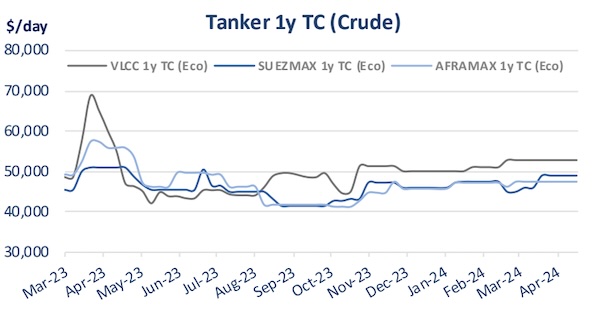
The tanker market is bound to be further impacted by the escalation of the Middle East tensions. In its latest weekly report, shipbroker Xclusiv said that “news of an Israeli strike on Iranian territory, potentially escalating tensions in the Middle East, sent shockwaves through global markets. Geopolitical uncertainties loom large, capable of swiftly altering the trajectories of commodities such as oil, and reigniting concerns over inflation. Although oil prices took a rollercoaster ride on Friday, with WTI climbing to USD 86/barrel, reports suggested the attack was less extensive than initially believed, with Iran’s key nuclear facilities seemingly untouched. Additionally, Iran downplayed the attack and any possibility of immediate retaliation. This reassessment of the situation caused oil prices to erase earlier gains, with WTI closing the week at USD 82/barrel”.
Source: Xclusiv
According to the shipbroker, “rising tensions in the Middle East and stricter sanctions against Iran could impact the supply of LPG, posing risks to Iranian exports. Concurrently, ongoing cuts by OPEC+ are further limiting outflows from the region. Iran, a significant player in the LPG market, saw exports of around 1,000,000 metric tons in March, with April’s volumes currently standing…